
Grant County Deed Records Defined
The Register of Deeds keeps a broad land-record run. Deeds sit beside mortgages, releases, contracts, financing statements, tax liens, easements, assignments, powers of attorney, affidavits, plats of additions, and oil-and-gas papers. The instrument label frames the event. The full text and legal description still control any comparison.
| Deed type | What it does | Common use |
|---|---|---|
| Warranty deed | Conveys the described interest with stated covenants | Follow a conventional sale |
| Quitclaim deed | Conveys whatever interest the grantor may hold | Test family or correction transfers |
| Executor deed | Conveys through an estate representative | Connect probate authority to land |
| Sheriff or tax deed | Records a court or tax-sale transfer | Follow foreclosure or delinquency |
| Correction deed | Repairs stated details in an earlier paper | Resolve name or description conflicts |
A deed may not convey every interest in the land. Read all reservations, exceptions, and tract calls before assuming the surface, minerals, or other rights changed hands.
Grant County Deed Counter
The Grant County Register of Deeds works from the courthouse lower level at 108 S. Glenn Street in Ulysses. Julie K. Widder serves as the register. The office posts a phone line at 620-356-1538 and keeps weekday hours, Monday through Friday, 8 a.m. to 5 p.m. Most land records stay open to the public during those hours.
The Register of Deeds publishes no online deed index, no image subscription, and no searchable web archive. The counter itself is the search surface. Come prepared with name variants, a rough date range, a legal description, and any book, page, or instrument number you already have. Staff can also explain how the direct and reverse indexes are organized, which helps when you trace ownership across several deed records.
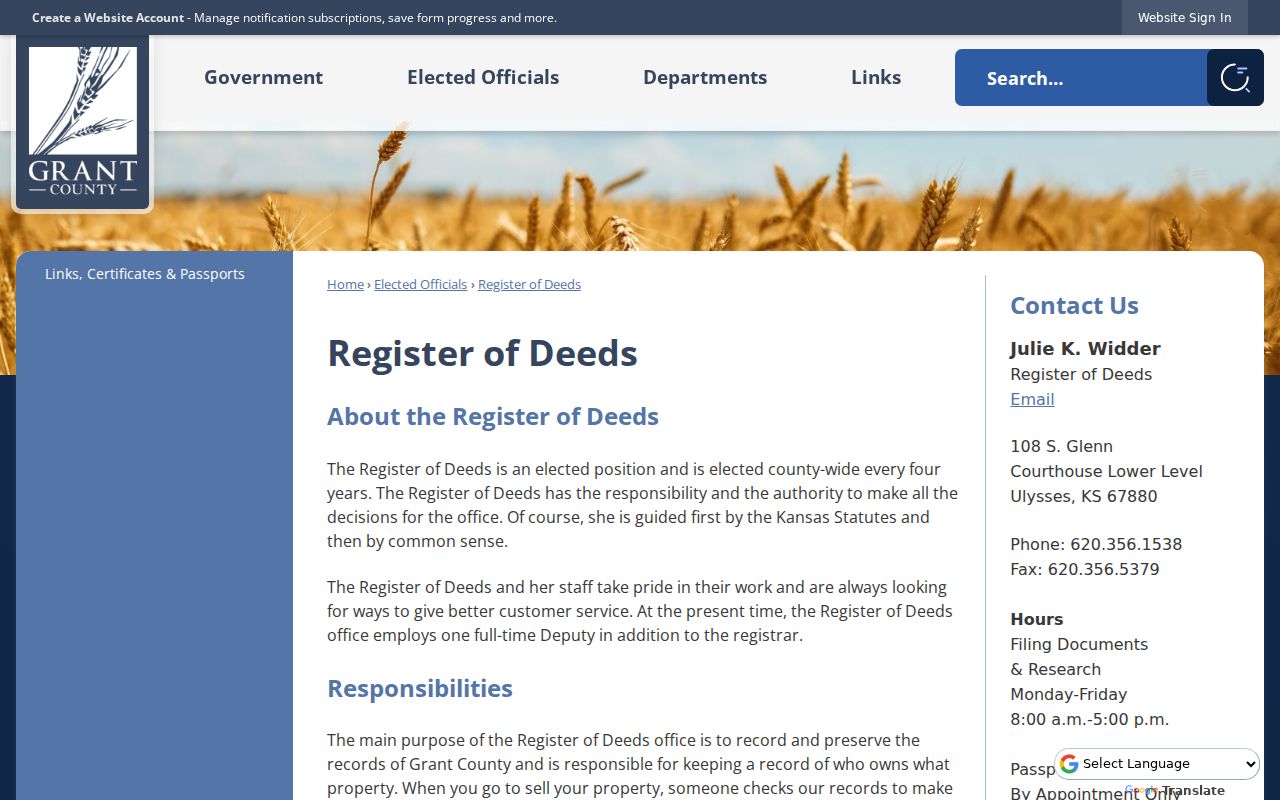
The official page posts no online grantor-grantee search form.
Build the Grant County Deed Chain
A grantor conveys an interest. A grantee receives it. The chain of title links every instrument touching the same described land, so each step must match both the parties and the parcel.
- Search the current owner clue as grantee and locate the newest deed into that name.
- Copy the date, type, parties, legal description, and book/page or instrument number.
- Search that grantor as a grantee to find how the prior owner acquired the tract.
- Repeat while the description matches, flagging splits, exceptions, corrections, and mineral reservations.
- Search later grantor entries to find out-conveyances and test whether each covered all or part.
- Direct index
- An index commonly arranged by grantor.
- Reverse index
- An index commonly arranged by grantee.
- Book and page
- A volume and page locator.
- Instrument number
- A distinct recording identifier.
Grant County Deeds Follow Land
A street address is only a clue. It is not the land identity used in many Grant County deeds. Papers may cite an Ulysses addition with lot and block. Others use a rural section-township-range description. Addresses change and parcels split, and a Ulysses ZIP can reach beyond city limits. The legal description is the safer bridge. It links a deed, plat, easement, and mineral record.
Copy each direction, fraction, lot, block, addition, section, township, and range notation. Parties can match while acreage differs. A partial deed can convey one tract or interest while the grantor keeps the rest.
Ulysses moved in 1909. Old Ulysses and New Ulysses both appear in historic records. Search both place names and take the addition or survey description to the deed counter.
Grant County Deeds and Burdens
A land search reaches beyond conveyances. A mortgage secures debt. A release records that a stated lien was released. An assignment changes the secured party, and an easement may grant use or access rights. Match each release to the original recording reference and the same land. Age alone does not clear a mortgage.
Judgment liens may need the District Court case plus the recorded abstract, while county tax issues require the Treasurer account and any later tax or sheriff deed. The court file and the recorded instrument stay linked but separate.
Grant County sits in the Hugoton gas field context. Surface ownership can differ from mineral ownership through reservations, leases, assignments, and mineral deeds. When a deed points below the surface, search lessor, lessee, operator, and entity variants.
Grant County Salt-Mine Microfilm
The Register of Deeds keeps a copy of every document. The office microfilms all records each year. Microfilm is stored in the Hutchinson salt mines. That step gives Grant County deed records an offline path. No online cutoff year is published.
The Kansas Historical Society county inventory omits Grant County. That omission does not disprove the local statement. One source describes local preservation, while the other serves as a statewide finding aid. Call the register for the exact book, index, or reel location. Then ask KSHS about any cataloged or unlisted holding.
The earliest deed book and first digital-imaging year remain unlisted. Do not request a loan yet. First confirm a holding institution and a reel or volume number.
Request a Grant County Deed
A focused request names the parties, deed type, recording date or range, legal description, and known locator, and states whether an uncertified research copy suffices or a certified copy is required. The office links filing fees. No research-copy or certification price is posted.
In-person access is the documented channel. Phone before mailing to confirm the locator and cost. When counter access stalls, a focused request under the Kansas Open Records Act can work. K.S.A. 45-218 covers access, and K.S.A. 45-219 permits reasonable fees.
Annual microfilm is a preservation copy. It is not proof that remote images are sold online, so ask where the requested year and index can be used.
Grant County Probate Deed Branches
An estate transfer rarely runs in a straight seller-to-buyer line. The District Court file may hold public orders. The Register of Deeds, meanwhile, keeps the executor deed, an affidavit, or a later conveyance. Search the decedent, the estate style, the representative, and the heirs as separate clues. Each name can open a different door.
The Kansas Courts Public Access Portal is the statewide route under Rule 22. A courthouse terminal or the clerk's physical file works as an alternative. Protected material is excluded either way. And remember, a docket entry alone never transfers land.
Match the court's authority to the recorded paper through parties, dates, and the legal description. Keep a partial sale as its own link in the chain. An heir's quitclaim deed deserves the same treatment.
Ulysses Plats in Grant County Deeds
The register specifically keeps plats of additions to Ulysses. A plat maps out lots, blocks, streets, and easements. A deed often names an addition rather than a current street address. The map often explains why.
No official source publishes a full list of additions. Ask the office for the plat roster and search under the exact recorded name. Near city limits, compare the county deed with city zoning. The postal city is not always the jurisdiction.
The 1909 move from Old Ulysses to New Ulysses adds a historic wrinkle. Follow the lot, block, addition, and date straight through the deed books.
Grant County Deed Alert Gap
Grant County offers no property-fraud alert signup. Do not promise email monitoring. Instead, keep the latest deed reference. Check later grantor entries, and contact the register about any unfamiliar filing.
Preserve the instrument number, parties, date, notary details, and legal description. Staff can explain how to get copies. They will not decide whether a signature is valid.
Ask the office whether an alert service has launched. Until one is confirmed, counter checks and focused KORA requests remain the official routes.
What Grant County Recording Proves
Recording places a paper in the public land-record system. That is all it does. It does not guarantee the signer held good title, that every interest moved, or that no later paper changed the answer. A recorded deed can be corrected or superseded, and an unrecorded interest may raise a legal issue beyond any index search.
Recorded, not guaranteed. Grant County deed records provide public notice and a chain to inspect, but they are not a title opinion.
These records serve purchase review, estate work, easement questions, mineral research, and land history well. Ownership, lien priority, and boundary disputes are different matters. Those need title work. When legal rights turn on them, obtain the needed survey or legal analysis. Public names and addresses must never be used to stalk, harass, or harm a person.
Deed work benefits from a written search log. Record every spelling, date range, index checked, and staff-supplied locator. When a name search fails, reverse the approach. Start with the legal description, a plat, a mortgage, a release, a court case, or a tax-sale reference. Recover the parties from that record. For rural land, log the section, township, range, acreage, and directional fractions. For an Ulysses lot, log the addition, block, and lot.
Keep plain copies for research. Request certification only when the receiving process requires it. Certification authenticates the copy but does not cure title. If a document is hard to read, ask whether another copy or a microfilm image exists. Compare names, signatures, acknowledgments, recording stamps, and description pages. Do this before linking the deed to the chain. A missing attachment can change what the deed appears to convey.
Before closing the file, compare the last deed with each later release, assignment, affidavit, correction, and court-based paper. Preserve full description pages and recording stamps. A missing page can change the apparent result.