
What Grant County Property Tax Records Can Establish
A full Grant County property tax inquiry draws on two offices at once. Valuation and classification come from the Appraiser. The bill itself comes from the Treasurer. Payments, interest, and delinquency sit there too. The county's tax roll search does not always respond, so field labels there vary. Ask either office to confirm the core items for a parcel.
| Field | What It Shows | Where |
|---|---|---|
| Appraised value | Estimated fair market value assigned for tax administration | Grant County Appraiser |
| Assessed value | Appraised value multiplied by the Kansas class rate | Grant County Appraiser |
| Classification or exemption | Use class and any adjustment affecting the taxable base | Grant County Appraiser |
| Tax bill and status | Amount billed, payment, interest, and delinquency | Grant County Treasurer |
| Taxing districts and levies | The local entities whose levies contribute to the bill | Treasurer and County Clerk |
Kansas builds the tax figure from appraised value, an assessment rate, and the mill levy. Assessed value is therefore not a sale price. A deed's consideration amount records a transaction. The tax number reflects the annual valuation system. For a closer look at those figures, see the Grant County property value guide.
The Grant County Appraiser and Treasurer Keep Different Tax Records
County Appraiser Cynthia Wellbrock works from the third level of the courthouse at 108 S. Glenn in Ulysses. The office keeps weekday hours, 8 a.m. to 5 p.m., Monday through Friday, at 620-356-3362. Its official description charges staff with discovering, listing, and valuing all property. The office applies state law. It weighs recent sales and local economic conditions each year. That job is equalization, not a private appraisal of one owner's parcel.
Treasurer Terri Trotman's tax counter sits in the same courthouse and handles the billing side. Hours match the Appraiser's weekday schedule, and the tax office answers at 620-356-1551 and 620-356-3886. A parcel's value looks wrong? Call the Appraiser. The value is right but the amount due or a payment posting seems off? Take it to the Treasurer.
How Kansas Turns Grant County Appraised Value Into Assessed Value
The Kansas Department of Revenue lays out the sequence plainly. Appraised value times the assessment rate yields assessed value. The mill levy then applies to that assessed amount. Residential real property generally carries an 11.5 percent assessment rate. Commercial and industrial real property generally sits at 25 percent. Vacant lots run about 12 percent. Qualifying agricultural land is valued by agricultural use and assessed at 30 percent.
- Appraised value
- The county's estimate of fair market value for tax purposes, except where Kansas requires another method.
- Assessed value
- The taxable base after the class assessment rate is applied.
- Mill levy
- The combined local tax rate applied to assessed value.
- Tax lien
- The public claim that can arise when real-property tax remains unpaid.
Use and classification drive the outcome. A house, a vacant tract, a business property, and agricultural ground rarely share one class rate. Confirm the class on the actual Grant County record before doing any math.
Grant County Property Tax Records Follow a Yearly Calendar
Kansas sets January 1 as the valuation date for real property. Value notices go out from the county by March 1. Taxpayers have 30 days from that mailing to appeal. State certification and local review follow. Then, in mid-November, Grant County mails its tax bills. A valuation question comes up months before any payment question does.
Real and mineral property tax is due December 20. Payment can be made in full or as a first half. Miss the first half and interest accrues. It can still be paid through May 10. That date is when the second half comes due. The Treasurer mails second-half reminders in early April. Hold onto the notice, bill, and receipt. Each one records a different step in the Grant County property tax cycle.
Look Up a Grant County Tax Bill Through the Verified Routes
The county Quick Links page points to an eCountyWorks Tax Roll Search. That host does not always load. Its address, owner, parcel, and value fields cannot be guaranteed sight unseen. Try the linked route first. If it fails, move promptly to the Appraiser and Treasurer. Do not read an error page as proof that no record exists.
- Try the county-linked Tax Roll Search with the identifying facts the live page accepts.
- If it fails, call the Appraiser with the street address, owner name if known, and legal description or parcel number.
- Ask the Treasurer to confirm the tax year, bill amount, payment posting, interest, and delinquency status.
- Compare the parcel and legal description across both offices before relying on the result.
The online payment route requires the PIN printed on the tax statement. That PIN requirement is documented, while an open public search field is not. A bill that never arrives should go to the Treasurer at 620-356-1551.
Grant County Property Tax Payment Channels
The Treasurer accepts payment several ways. Taxpayers can mail funds to the Grant County Treasurer. They can use the courthouse east-side drop box. They can pay online with the statement PIN. ACH can be arranged through the county's ACH Authorization Form. Confirm current instructions before sending money. Identify the parcel and tax year clearly on anything submitted.
A corrected bill can change the amount once an error is fixed. Grant County also tells taxpayers to contact the Treasurer when a bill never arrives. Nonreceipt does not erase the due date. So holding onto the statement PIN and a payment record is simply practical.
Late Grant County Property Tax and the Foreclosure Trail
Unpaid real or mineral property taxes in Grant County draw interest from the start. The pressure builds on a schedule. After August 1, delinquent taxes may be advertised in a newspaper. A $16 advertisement fee lands on the account. Three years of unpaid tax opens the door to a county tax-foreclosure public auction. That trail is documented in pieces: the Treasurer's account, the published notice, the court file, and any later instrument recorded with the Register of Deeds.
A newspaper notice is only a lead. It is not a current balance. Confirm the amount and the parcel number with the Treasurer before acting on anything. If litigation has begun, Grant County sits in the Kansas 26th Judicial District. The statewide public portal or the courthouse terminal provides the case route under Kansas Rule 22.
The Official Kansas Property Tax Calendar in Context
The Kansas Department of Revenue calendar sets out the sequence from valuation notice through appeal, certification, billing, and payment. Grant County property tax records follow that same cycle each year.
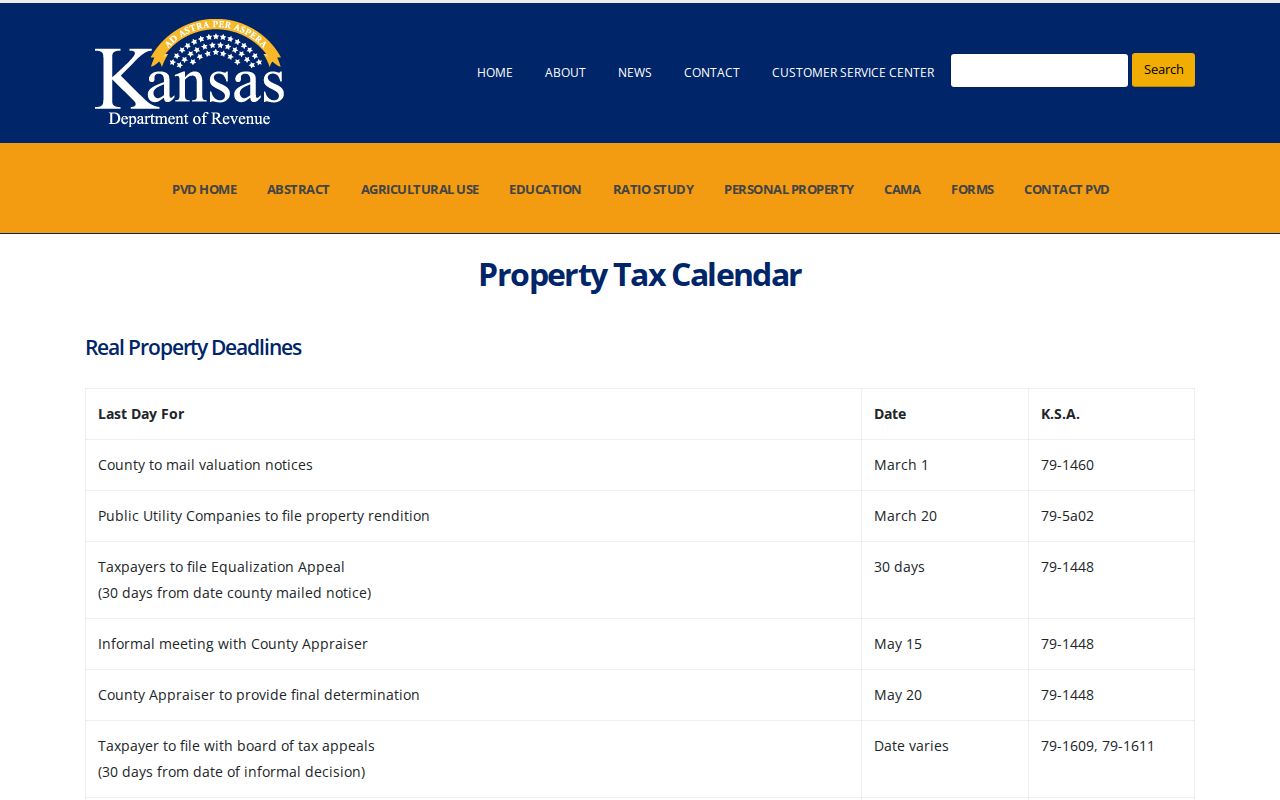
The state calendar supplies only the framework. The Grant County Appraiser and Treasurer confirm what a specific parcel actually received, from its valuation notice to the account balance tied to its parcel number.
Contest a Grant County Assessment Through the Right Appeal Route
Start with the Appraiser. A valuation notice is the trigger, and Kansas offers two main ways to contest it: an equalization appeal during the spring notice cycle, or a payment-under-protest route tied to the tax payment. Each path needs evidence. Comparable sales, an independent appraisal, photographs, and repair estimates all fit, as do income and expense records for income property. Facts showing a classification or physical-description error also work. The aim is to test value and uniformity for the stated valuation date, not simply to argue the tax bill is high.
Protect the deadline. A real-property equalization appeal is ordinarily due within 30 days after the value notice is mailed; confirm the date on the notice with the Appraiser.
Do not file both appeal routes for the same valuation issue without checking Kansas rules first. The Kansas Board of Tax Appeals handles later review stages and is linked from the county Appraisal page. Keep the notice, the filing, the evidence, and the decision together as one record set.
A Published Levy Is Context, Not a Current Grant County Bill
The official 2024 levy schedule shows how local levies look in a dated public record. It lists a City of Ulysses line at a valuation of $39,956,406. A library line appears there too. That detail is context, not a current bill. The schedule is not a 2026 rate. It says nothing about what one parcel owes. County budget hearings and later certifications can also change the tax setting. That affects the setting for the next tax cycle.
That distinction keeps Grant County property tax records tied to their year. Cite the levy publication by date. Then rely on the parcel's actual tax bill for any decision. Current confirmation from the office matters just as much.