
Four Numbers Can Describe a Grant County Property Value
"Value" can mean the Appraiser's full value. It can also mean the assessed amount once the class rate applies. Elsewhere it is a sale consideration recorded in a deed, or the final tax produced when levies meet assessed value. So check the year beside every number.
| Value | What It Is | Where |
|---|---|---|
| Appraised value | Estimated fair market value for tax administration, except where another method applies | Grant County Appraiser |
| Assessed value | Appraised value after the Kansas class assessment rate | Grant County Appraiser |
| Sale consideration | The amount stated, if any, in a recorded transfer | Register of Deeds instrument |
| Property tax | The result of assessed value and the applicable levy | Grant County Treasurer |
These figures can differ while every record stays right. They answer distinct questions on distinct dates. A transfer may carry nominal, exempt, partial-interest, or other non-market consideration, so the deed needs to be read in context.
Kansas Class Rates Shape Grant County Assessed Values
Assessed value is appraised value times the class rate. Residential real property is generally assessed at 11.5 percent. Commercial and industrial land sits at 25 percent. Vacant lots carry 12 percent, and qualifying agricultural land is valued by agricultural use and assessed at 30 percent. Classification drives the whole calculation. Applying the residential percentage to farm ground or commercial property would produce a false estimate. Confirm the class and use on the Appraiser's record before comparing assessed values.
- Appraised value
- The tax office's full-value estimate, subject to Kansas valuation rules.
- Assessed value
- The taxable base after the class rate is applied.
- Assessment ratio
- The percentage assigned by law to the property class.
- Sale consideration
- The price or value stated in a transfer instrument, which may need context.
- Reappraisal
- The required annual process of reviewing real-property values.
Grant County Reviews Property Values Each Year
The Appraisal page lays out the county's approach. The office discovers, lists, and values all property. It also weighs recent sales plus local economic conditions in an annual review. Kansas law sets the valuation date for real property at January 1. Real-property value notices go out by March 1. The county runs this yearly cycle instead of relying on one isolated reassessment event. There is no separate countywide revaluation year to cite.
A Grant County property value only makes sense with its tax year attached. The effective date matters just as much. A later sale, new construction, a classification change, or a corrected property description may fall outside that annual snapshot.
Look Up a Grant County Property Value by Parcel
County Quick Links name eCountyWorks as the Tax Roll Search. Its exact address, owner, parcel, and value fields are not standardized. Try the official link first, then use the Appraiser's office as the fallback.
- Try the county-linked tax roll with the fields the live service actually presents.
- If unavailable, give the Appraiser the address, owner clue, parcel number, or legal description.
- Ask for the tax year, class, appraised value, assessed value, and any land or improvement split shown.
- Use the Register of Deeds instrument for recorded consideration rather than assuming a tax field equals price.
- Situs address
- The physical location used to begin a search.
- Mailing address
- The tax-notice destination, which may not be the property.
- Legal description
- The deed and plat identity used to confirm the correct land.
Copy the parcel identifier exactly. It can change after a split, combination, or re-parceling, and it is not the same as a deed document number.
The Grant County Appraiser Is the Value Custodian
The official Grant County Appraisal page names Cynthia Wellbrock and explains the office's annual valuation duty.
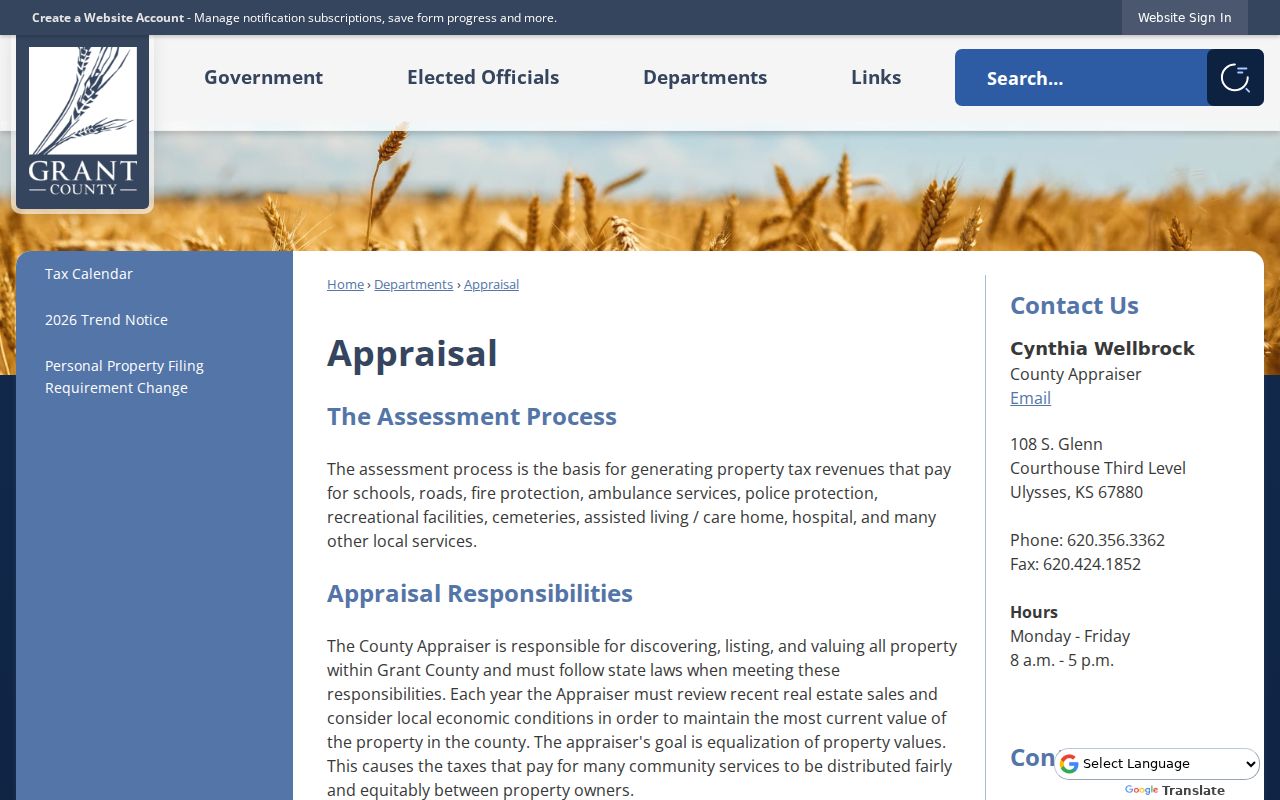
The page confirms who keeps the records. It does not embed a public parcel card or display exact result labels.
Recorded Consideration Is Not the Same Grant County Value
The Register of Deeds keeps conveyances, contracts, affidavits, assignments, and other land instruments. A latest deed may state its consideration. The office page offers no online sample or image. Ask the counter for the recording reference. Then read the full instrument, because a sale can involve part of a parcel, a mineral interest, a family transfer, or an estate. Grant County sits over the Hugoton gas field. Surface title and mineral interests can diverge there. A consideration tied to one interest is not the price of every right in the land.
Kansas Ratio Studies Do Not Appraise One Grant County Parcel
The Kansas Department of Revenue publishes real-estate ratio-study reports. These test appraisal level and uniformity across sales. They measure the system, not one property. No report gives a licensed opinion of value for a single house, farm, or commercial tract. A parcel-specific comparison needs the right class, date, physical characteristics, and market evidence. State statistics add context, but they cannot replace the county record or a professional appraisal.
Ulysses Revitalization Records Track Value Increases
Grant County's Neighborhood Revitalization program covers a Ulysses-centered area reaching three miles past the city limits. The county page sets a $5,000 increase in appraised value as a threshold. It directs owners through the Appraiser's process. That boundary defines a program area only. It proves nothing about title or city limits. The relevant number is an increase tied to qualifying improvements and program rules. It is not a sale forecast.
What a Grant County Property Value Does Not Tell You
The Appraiser's figure backs a mass appraisal system. It does not promise a sale result. It cannot reveal every condition inside a building, establish title, or locate a legal boundary. A recorded price is historical, while an assessed value is a taxable base, and neither should be relabeled as a current appraisal.
Value is not price. A Grant County assessed value is for taxation and is neither a sale prediction nor a licensed appraisal.
Levies, due dates, and protest routes live elsewhere. Use the Grant County property tax records guide for those mechanics, and the meaning of each value stays clear.